Questions
Common questions about home education
These are the questions I was asked, and the questions I asked, in the first few months. Short answers, honestly given, from a parent in the UK rather than from an organisation.
Two things before you read them. Where something depends on the law, I have said so and pointed you at the people who can actually answer it — home education works differently in England, Wales, Scotland and Northern Ireland, and advice that does not say which one it means is worth very little.
And I have not quoted any statistics. There are numbers in circulation about how many families do this and how their children turn out, and I could not verify a single one to my own satisfaction, so I have left them all out. What is below is experience and opinion, clearly labelled as such.
Is home education legal?
Yes. Educating your child at home instead of at school is a legitimate and long-established choice throughout the United Kingdom, and you are not doing anything unusual or borderline by considering it.
What differs — and it differs a great deal — is how you go about it and what your local authority's role is afterwards. England, Wales, Scotland and Northern Ireland each have their own arrangements. The one I would make sure of before reading anything else: in Scotland, taking a child out of a public school needs the local authority's consent, which is not how it works in England. A Scottish parent following English advice is the most common serious mistake in this whole subject.
You may also have read that new registration duties are coming. Some have been legislated for and are not yet in force, and the detail has moved more than once. Treat anything you read about them as a description of what may happen rather than of what you have to do today, and check the current position rather than a blog post.
Where to check, and I mean this rather than treating it as a disclaimer: your own local authority's elective home education page, and the current guidance published by the government for the nation you live in. Those two are the only sources that bind you. Nothing on this page is legal advice.
How do I actually start?
Start by getting clear on why, and only then find out what the process is where you live. Those two, in that order, are the whole of the beginning — and doing them the other way round is what makes the first month feel like paperwork instead of a decision.
The why matters because you will be asked. By a relative, by a teacher, by yourself at eleven o'clock at night. A parent who knows their own reasons can hear all three without coming apart. That is what the free workbook is for, and it is free because this is the part nobody should be charged for.
Then the practical bit, which is genuinely local: what you have to do, and who you tell, depends on which nation you are in and whether your child is currently on a school roll. Ask your local authority directly. In my experience they answer, and the answer is shorter than the internet suggests.
What I would not do is build a year. Plan the next fortnight. The single most common thing families change in the first term is the plan they made before they started.
What about GCSEs and exams?
Home-educated young people do take GCSEs and other qualifications. They are arranged privately rather than through a school — you find a centre that accepts external candidates, and you enter and pay for each subject yourself.
Two things about that are worth knowing early, because they are the two that surprise people. Cost is per subject and it adds up, so the number of subjects becomes a real decision rather than an assumption. And availability is properly local: some areas have several centres that take external candidates and some have almost none, which can mean travel. Both are worth finding out about years before you need to, not months.
I am not going to tell you it is as simple as it is inside a school, because it is not. What I would say is that it is a logistics problem rather than a barrier, and that treating it as one from the start takes most of the fear out of it.
Exam-centre availability, fees and entry deadlines change every year and vary by awarding body, so check with the centres near you and with the awarding bodies directly rather than relying on anything written down here.
Do I have to be a teacher?
No. I did work in education before we started, and I want to be straight that it helped less than you would think — most of what I knew was about running a classroom of thirty, which is a different job from this one and occasionally the opposite of it.
What actually seems to matter is knowing your own child, being willing to find things out alongside them, and being honest when something is not working. None of those is a qualification.
What if my child is struggling at school?
This is the most common reason families arrive at home education, and it deserves a more careful answer than most of the questions above.
What I can tell you honestly: for a lot of families, taking the daily pressure off changes the atmosphere at home quickly, and that alone is worth a great deal. What I cannot tell you is whether it will do that for your child, or whether home education is the right answer to whatever is happening. I am a parent and a former educator, not a clinician, and anyone who offers you a confident answer to that question without knowing your child is guessing.
If a child is distressed, unwell, or not coping, the people to talk to are the ones who can actually assess that — your GP, the school's SEND team, whoever is already involved. Home education can be part of what helps. It is not a substitute for finding out what is wrong.
Nothing here is medical or psychological advice, and nothing here is advice about special educational needs provision, which is specific to a child and to where you live.
Am I doing enough?
Almost every home-educating parent I know asks this, including the ones whose children are visibly thriving. It is worth knowing that the question is close to universal, because the feeling it produces is that you are the only one.
The trap is that "enough" is usually borrowed from school without being examined — hours at a desk, subjects covered, pages filled. Those are how you run a building with a thousand children in it. They are not much use as a measure of one child's week.
What I find more useful is to look backwards rather than sideways. Not "are we keeping up", which has no answer, but "is this child different from how they were six months ago" — which does, and usually a reassuring one.
Can I do this and still work?
Plenty of families do, and the arrangements look nothing like each other — part-time hours, self-employment, shifts split between two parents, grandparents, work that happens after eight o'clock at night.
What I would not do is pretend it is free. It costs either income or hours, usually some of both, and a family deciding this should look at that honestly rather than being told it works out. It is a real trade, and it is one a lot of people make on purpose.
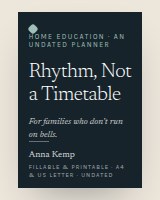
If one of those was your question.
The first one is where most people start, and it is the one thing on this site I would press on you.
What about socialisation?
Home-educated children are not at home all day. Ours are out more than they were at school — groups, activities, other families, people of a range of ages rather than thirty children born in the same twelve months.
The honest version is that the friendships do not arrive by themselves, and that is the real difference. At school they are a by-product of the building. At home they are something you arrange, at least at first, and that takes effort in the weeks when you have least of it. The families who find this hardest are usually the ones who have not yet found their two or three regulars.
The way I have come to think about it: the question is not whether a child is around other people, it is whether they have somewhere they are known. That is worth more than a full calendar, and it is a different thing to aim at.